Why Speed Management Saves More Fuel Than Route Optimization
Most fleet managers chase fuel savings in the wrong order. They invest in routing software, audit fuel stop locations, and negotiate card discounts — all smart moves — while completely ignoring the single biggest variable in their fuel equation: how fast their drivers are going.
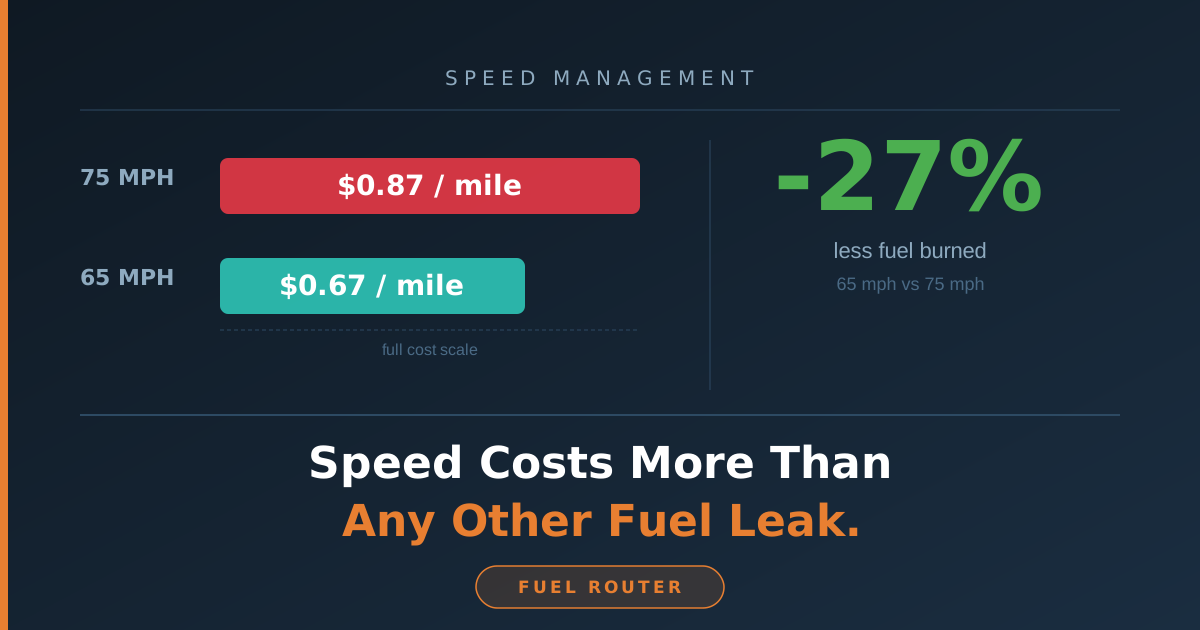
Every 1 mph over 65 costs your fleet 0.14 mpg. That number comes from the Department of Energy, and it compounds fast. A driver running 75 mph instead of 65 is burning 27% more fuel for every mile they cover. No routing software, fuel card discount, or stop optimization comes close to offsetting that.
Here's why speed management consistently beats route optimization for fuel savings, and how to capture it on your fleet today.
Quick Takeaways
- Every 1 mph over 65 costs 0.14 mpg — a truck at 75 mph burns 27% more fuel than the same truck at 65 mph
- A 50-truck fleet dropping average speed from 72 to 65 mph saves an estimated $180,000–$250,000 per year in fuel — with zero new software
- Speed management is the only fuel lever that's free to implement today using ECU limiters already on most Class 8 trucks
The Math Most Fleet Managers Haven't Run
Let's get specific. A Class 8 semi at highway cruise gets roughly 6.0 mpg at 65 mph. Here's what happens as speed climbs:
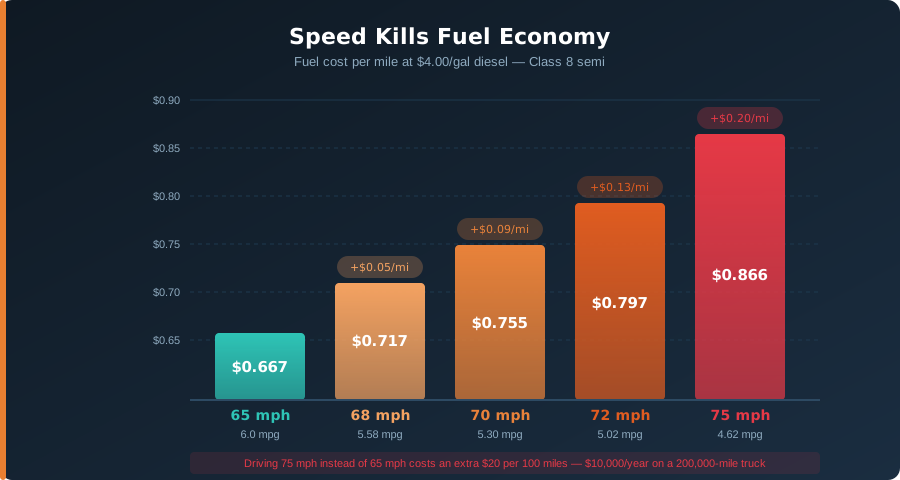
That last column is what matters. A driver running 75 mph is spending 20 cents more per mile than a driver at 65 mph — just from speed.
For a truck doing 100,000 miles per year, that's $20,000 per truck per year in avoidable fuel cost. On a 50-truck fleet, you're leaving $1 million on the table annually if your average speed is 75 mph versus 65 mph.
Even a more realistic comparison — 72 mph versus 65 mph — saves $13,000 per truck per year. That's $650,000 across a 50-truck fleet.
Speed vs. Route Optimization: An Honest Comparison
Route optimization is valuable. Fuel stop optimization is valuable. But they have a ceiling that speed management doesn't.
Route optimization saves fuel by finding shorter paths or avoiding idle-heavy corridors. In practice, most OTR routes are already reasonably optimized — shippers specify origin and destination, HOS limits constrain options, and major corridors don't have dramatically better alternatives. Realistic savings: 3–8% on fuel, depending on route variability.
Fuel stop optimization saves money by buying diesel where it's cheapest along an existing route. This is real money — 15–30 cents per gallon in the right corridors — but it doesn't change how much diesel you consume. It changes what you pay per gallon.
Speed management changes how much diesel you consume, period. It applies to every mile driven, every truck, every day. And unlike routing changes (which require dispatch software and planning overhead) or fuel stop optimization (which requires real-time price data and driver compliance), speed enforcement requires exactly one thing: setting an ECU speed limiter.
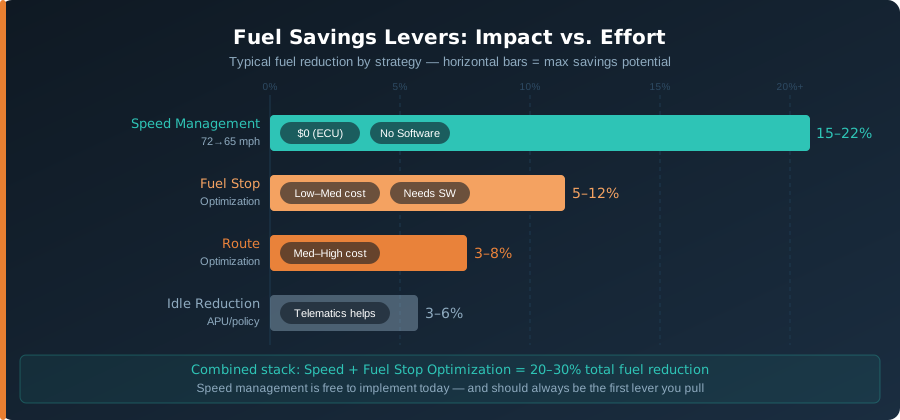
Speed management wins on both impact and implementation cost. It should be the first lever, not the last.
Why Fleets Don't Enforce It (And Why That's a Mistake)
The pushback on speed limiters is almost always the same: drivers hate them, and slower trucks mean slower deliveries.
Both concerns are worth addressing directly.
On driver resistance: Drivers who have driven 75+ mph for years will initially push back on speed limiters. This is real but manageable. The ones who adjust quickly are the ones who understand that their jobs depend on the fleet's profitability. Frame it that way. For owner-operators contracting to your fleet, consider making speed compliance a condition of continued contract.
On delivery timing: The math doesn't support the concern as strongly as drivers claim. A truck traveling 500 miles at 75 mph arrives in 6 hours 40 minutes. The same truck at 65 mph arrives in 7 hours 41 minutes — about an hour later. On most OTR loads, that hour is absorbed by dock wait times, HOS breaks, and scheduling buffers. If your freight is truly so time-sensitive that one hour per 500 miles is unacceptable, you have a different problem than fuel costs.
The reality: most fleets that implement speed limiters at 65–68 mph see initial driver complaints followed by normalization within 30–60 days. The fuel savings show up on the first fuel card statement.
How to Implement Speed Management Without a Fight
Step 1: Use the ECU limiter you already have. Every Class 8 truck built after 2005 has an ECU (engine control unit) that can be programmed with a speed limit. Most fleets have never touched this setting. Your fleet's diesel mechanic or a Cummins/Detroit/PACCAR dealer can set it in 15 minutes per truck. Cost: $0–$50 per truck in labor.
Step 2: Set it at 65–68 mph, not 55. Going from 72 to 65 mph captures most of the savings without the delivery timing friction. Going to 55 mph is a different conversation and usually not necessary.
Step 3: Layer telematics for ongoing enforcement. ECU limiters handle top speed, but don't catch acceleration patterns, cruise speed choices, or drivers who found workarounds. A basic telematics system (Samsara, Motive, KeepTruckin) gives you speed reports by driver so you can catch outliers. Most fleets already have this — they just aren't running the speed compliance report.
Step 4: Pair speed discipline with fuel stop optimization. Speed management reduces how much diesel you burn. Fuel stop optimization reduces what you pay per gallon. Running both compounds the savings. A fleet that drops from 72 to 65 mph AND routes fuel stops to the cheapest diesel on each corridor can realistically cut fuel spend by 20–30% combined.
What This Looks Like in Real Numbers
Let's model a realistic mid-sized fleet:
- Fleet size: 30 trucks
- Annual miles per truck: 110,000
- Current average speed: 71 mph
- Current MPG: 5.45
- Diesel cost: $4.00/gallon (before the current spike — at $4.86, savings are even larger)
Current annual fuel cost: 30 trucks × 110,000 miles ÷ 5.45 mpg × $4.00 = $2,422,018
After enforcing 65 mph average (MPG improves to 6.0): 30 trucks × 110,000 miles ÷ 6.0 mpg × $4.00 = $2,200,000
Annual savings: $222,018 — from one policy change.
At current diesel prices ($4.86/gallon), that same calculation saves $269,000 per year.
The Bottom Line Speed management is the highest-ROI fuel lever in trucking, and most fleets aren't using it intentionally. Every mph over 65 costs 0.14 mpg — the math adds up to six figures annually on any fleet over 20 trucks. Set the ECU limiter, run telematics speed compliance reports, and pair it with route-aware fuel stop optimization. The combination consistently outperforms any single tool or strategy alone.
See how much your fleet's speed profile is costing you. Get a free fuel savings estimate from Fuel Router →
Related reading:
- How Much Does Fuel Cost Per Mile for Semi Trucks in 2026?
- Idle Time Is Eating Your Fuel Budget: Here's the Math
- 7 Ways Fleet Dispatchers Can Cut Fuel Costs Without Rerouting
How Much Are You Overpaying for Diesel?
Enter your fleet size and see your estimated annual savings in seconds — free, no email required.
Get Your Free Savings Estimate →